
How to Design a Backyard You'll Actually Use
Most backyard renovations start with a Pinterest board or a Houzz folder. Pavers that caught someone's eye. A fire pit that looked right in a photo. Ornamental grasses that seemed like the right texture. The aesthetic decisions come first, and the functional ones get worked around them later — or don't get made at all.
The result is a yard that looks good in June and gets used twice before August. The furniture sits. The fire pit becomes a planter. The space that was supposed to become the center of summer ends up being something people walk past on the way to somewhere else.
The yards that actually get used from May through September are designed in a different order. Function first. Materials second. Plants last. That sequence isn't intuitive when you're looking at inspiration photos, but it's the difference between a backyard that earns its cost and one that doesn't.
Answer the functional questions before you make any design decisions
Before any conversation about pavers versus concrete, pergolas versus shade sails, or which plants work in this climate, there are simpler questions worth answering honestly.
How many people are typically outside at once? A family of five uses outdoor space differently than a couple. The patio size that feels generous for two feels crowded for five, and a patio that feels generous for five is more than most couples want to maintain.
Do you cook outside, eat outside, or both? Cooking and eating outdoors require a spatial relationship between surfaces that has to be planned. A grill positioned eight feet from the seating area works. One positioned twenty feet away, across a lawn, gets used less because the logistics of moving food from one to the other add friction to an activity that should feel easy.
Do kids need room to move? If yes, the lawn is infrastructure, not decoration, and its size and location relative to the patio affects how much the adults use the patio. A lawn that sits where it can be seen from the seating area means parents can be outside with their kids without being in the middle of the activity. One positioned around a corner means nobody uses either space the way they intended.
Do you want low maintenance or are you willing to maintain what you build? This question gets skipped more than any other, and it's the one that determines whether a yard stays functional five years after installation or starts to feel like an obligation.
Where the patio goes matters more than what it's made of
In the Pacific Northwest, afternoon sun is not guaranteed but it is worth planning for. A patio on the north or east side of a home may be shaded exactly when you want to use it most. The material it's built from won't change that.
Walk your yard at three in the afternoon and again at six on a clear day. Note where the light is. Note where the shade falls. The primary outdoor living area belongs where the light is during the hours you intend to use it. That's a site observation that takes twenty minutes and determines whether the patio gets used or doesn't, regardless of what it's built from or how it looks.
The connection between the house and the patio matters almost as much as the location. A patio that sits disconnected from the back door, with no defined path and no visual relationship to the interior, gets used less than one that feels like a natural extension of the house. The transition should require no negotiation. That means a direct hardscape connection from the door to the main outdoor living area, wide enough for two people to move through comfortably at the same time.
Define zones without building walls
A yard where the lawn flows directly into the planting beds, which flow into the seating area, which flows into the play area, ends up feeling like none of those things work well. The spaces compete with each other rather than complementing each other.
Zones don't require walls or fences to read as distinct. A two-inch grade change between a patio surface and a lawn reads clearly as a boundary. A material transition from pavers to gravel communicates a shift in use without any vertical structure. Low planting borders establish edges that the eye reads as separation without creating enclosure.
The goal is a yard where each area has a clear identity. When someone walks outside, they know where to go and what that space is for. That clarity is what makes outdoor space feel comfortable to inhabit rather than vague and underused.
Shade is infrastructure, not an afterthought
July and August afternoons in this climate are warmer than most people account for when they're designing in April. An exposed patio that felt comfortable during the site visit in early spring can be genuinely uncomfortable on a clear afternoon in August.
If mature trees aren't providing canopy over the primary seating area, shade needs to be built into the design from the start. A pergola planned during patio construction is integrated, proportional, and structurally connected to the overall design. One added five years later to a finished patio is more expensive, structurally isolated, and almost always looks like exactly what it is.
The same logic applies to any element that addresses comfort. Outdoor heaters that extend the usable season into May and September are more effective and better looking when they're planned into the structure rather than plugged in afterward.
Lighting is what changes how many hours the space gets used
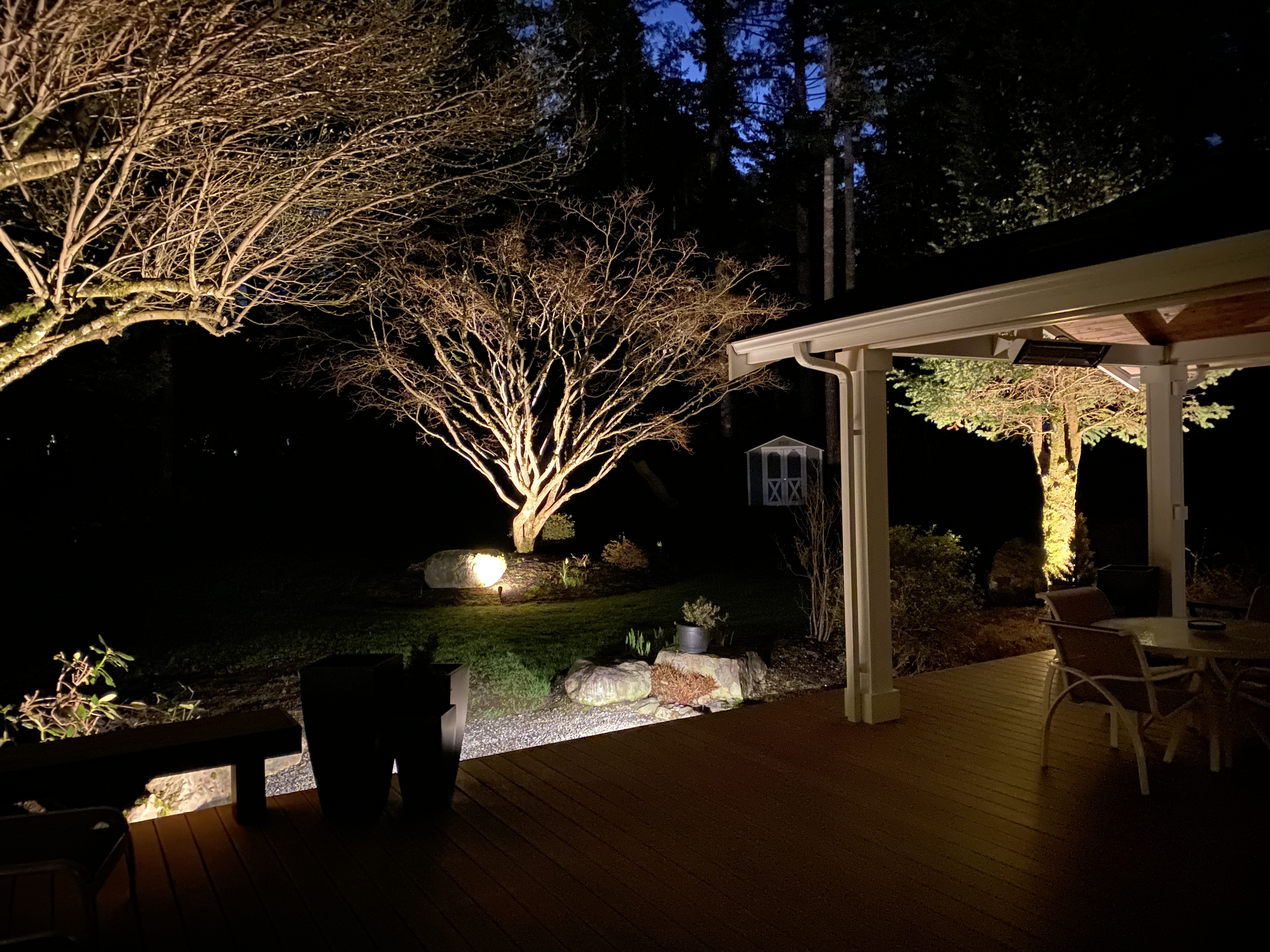
A well-designed backyard that goes dark at eight in the evening stops being used at eight in the evening. In a Pacific Northwest June, that means losing three to four hours of usable time on evenings when the light holds until ten or later.
Outdoor lighting doesn't require an elaborate installation to be effective. Path lights along a walkway, a few well-placed downlights in the seating area, and some ambient light on a pergola structure extend how late the space stays useful and change how the yard reads from inside the house after dark. The cost relative to the hardscape and planting is modest. The impact on how much the space actually gets used is not.
Wire runs and transformer placement are significantly easier to integrate during hardscape construction than after. If lighting is part of the eventual plan, roughing it in during the patio installation costs almost nothing compared to cutting into finished surfaces to add it later.
The sequence that determines whether it works
A backyard that functions well was designed in a specific order. The functional questions came first and determined the layout. The layout determined the hardscape scope and placement. The hardscape determined the grading and drainage requirements underneath it. The planting came last, after the surfaces and structure were established.
That order is not how most people approach the project, and it's not how inspiration photos present it. But it's the order that produces a yard that holds up — functionally and physically — for the years after the installation crew leaves.
A patio in the right location, connected cleanly to the house, with zones that are defined and comfortable, shade where you actually sit, and light that lets you stay outside past dark is more useful than a more elaborate yard where those fundamentals weren't addressed. Everything else performs better on top of that foundation.