
Excavation 101: When Do You Need a Professional Contractor?
A lot of property owners in the North Bend and Upper Snoqualmie Valley area approach excavation the way they approach most home projects: assess whether it's something you can do yourself, and if not, hire someone. The challenge with excavation is that the consequences of underestimating the scope aren't immediately visible — they show up six months later, or two winters down the road.
Here's a straightforward framework for knowing when to call a professional.
What Professional Excavation Actually Covers
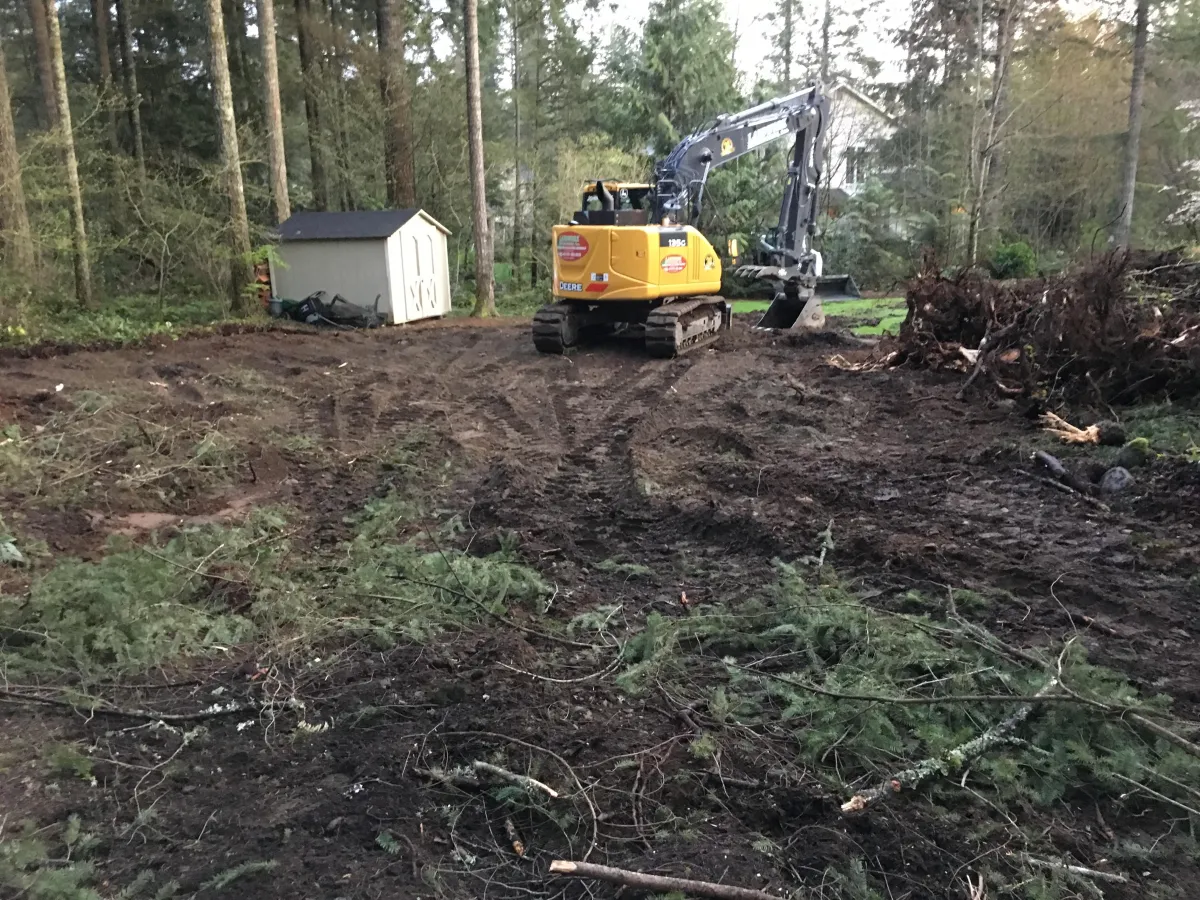
Excavation is any work that moves, grades, or removes soil at scale. That includes site clearing and grubbing before construction, foundation digging, septic system installation, drainage trenching, pond construction, road and driveway grading, land leveling for building pads, and utility trench work.
It also includes smaller projects that require precision — a retaining wall footing that needs to be level within tolerances, a drainage system that has to hit a specific grade, or a driveway that needs to shed water without erosion.
"In North Bend and the surrounding foothill areas, excavation isn't just moving dirt — it's working with soil that changes character within a few feet. Hardpan, buried rock, high-water-table conditions, and steep grade transitions are the norm, not the exception."
Signs You Need a Professional, Not a Rental Machine
The project is near utilities
Call 811 before any excavation — that's the law. But even with utilities located, working near gas lines, water mains, and fiber optic cables requires experience and equipment that can operate carefully in confined areas. The consequences of a mistake here are serious and expensive.
You're dealing with significant slope or height changes
Any excavation work on a slope steeper than 3:1, or work that creates a cut or fill greater than four feet, creates stability risk. Improperly cut slopes fail. Fill that isn't properly compacted settles. Both problems show up after the fact and cost more to fix than the original work would have cost to do right.
The work affects drainage patterns
Moving soil changes where water goes. An excavation project that improves drainage on one part of your property can create a new drainage problem somewhere else if the overall site hydrology isn't understood. A professional contractor assesses the full drainage picture before breaking ground.
You need permits
King County requires grading permits for projects that move more than 50 cubic yards of material, or for any grading near critical areas (steep slopes, wetlands, streams). North Bend and Snoqualmie have their own thresholds. A professional contractor knows what triggers permit requirements and what the review process looks like.
The timeline matters
Rental equipment is available when it's available. Professional contractors bring their own equipment and can schedule work around weather windows — which in this area, means working during dry periods and not creating an erosion problem by leaving disturbed soil exposed through a rain event.
What to Expect When You Hire an Excavation Contractor
A site visit before bidding is standard for any meaningful project. The contractor should walk the property, identify potential complications (rock, wet soil, limited access, utility proximity), and give you a scope of work in writing that includes what they'll do with removed material.
Get clarity on two things before signing: what the finished grade will look like and who's responsible for erosion control during the project. Disturbed soil that isn't stabilized causes problems quickly in a wet climate.
The DIY Threshold
Small-scale projects — a garden bed, a shallow trench for an irrigation line, moving a few yards of topsoil — are reasonable DIY territory with rented equipment or hand tools. The line is usually around 18–24 inches of depth, flat grade, no utility proximity, and limited scope.
Once you're past that threshold in any direction, the efficiency and risk profile of professional equipment and experienced operators justifies the cost.
The Bottom Line
Excavation mistakes are expensive and slow to reveal themselves. The North Bend area's combination of difficult soils, steep terrain, and complex drainage makes experienced local contractors worth the investment. Get the scope right, understand what you're moving and where it's going, and account for what the site will look like in a heavy rain before the job is done.