
Retaining Wall Options for Sloped Properties in King County
If your property sits on a slope, you already know the problem. Rain loosens soil. Gravity does the rest. Left unaddressed, a sloped yard erodes, shifts, and eventually threatens whatever sits above or below it — your lawn, your driveway, your foundation.
A retaining wall stops that process. But not all retaining walls are built the same, and in King County, where slopes range from gentle to severe and soil conditions vary widely, choosing the right material and design matters.
Why Sloped Properties in King County Need Attention
The combination of heavy clay soils, steep grades, and persistent winter rain creates ideal conditions for slope failure. Water saturates the soil, adds weight, reduces cohesion, and puts pressure on anything in its path. Most slope problems don't announce themselves dramatically — they build slowly through small movements and surface erosion until one wet season tips the balance.
A retaining wall intercepts that process by holding the uphill soil mass in place and directing water away from the slope rather than through it.
"In King County's clay-heavy soils, a retaining wall isn't just an aesthetic feature — it's a structural decision. An undersized or improperly drained wall won't fail slowly. It will fail suddenly, and usually in the middle of a wet winter."
The Main Options
Concrete Block (Allan Block / CMU)
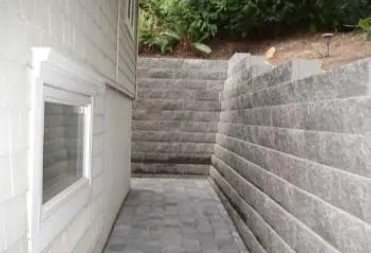
Concrete segmental retaining walls are the most common choice for residential properties. They're cost-effective, modular, and available in a range of finishes that blend with landscaping. For walls under four feet, a well-built block wall handles most residential slope situations without engineering review. Above four feet in King County, you'll typically need a permit and engineered drawings.
Poured Concrete
Poured concrete walls are stronger than block walls and perform better under heavy lateral loads. They're the right call when you're dealing with significant height, tight site access that limits block delivery, or when you need a smooth, clean face. They cost more and take longer to cure, but they're built to last decades.
Timber / Landscape Timber
Timber walls are inexpensive and can look good in naturalistic settings. The honest reality: they have a lifespan. Treated lumber in the Pacific Northwest typically holds 15–20 years before rot and soil pressure begin to compromise the structure. Fine for low walls in low-stakes areas. Not the right answer for anything load-bearing or taller than two feet.
Natural Stone and Boulders
Dry-stacked or mortared stone walls are the most durable option and the most visually compatible with a Pacific Northwest aesthetic. Boulder walls in particular require no mortar and can last generations when properly installed. They cost more because they require excavation equipment and an experienced installer who understands drainage and placement. For the right site, they're worth it.
Gabion Walls
Gabion walls — wire cages filled with rock — are increasingly popular for their drainage properties and naturalistic appearance. They flex slightly under load, which makes them more forgiving on problematic soils. They're a strong choice for steeper grades and properties near water.
What Every Retaining Wall Needs (Regardless of Material)
This is the part most homeowners don't hear until they're rebuilding a failed wall: drainage is as important as the wall itself. A wall with no drainage plan traps hydrostatic pressure behind it. That pressure will eventually push the wall over, regardless of how well it was built.
Every proper retaining wall includes drainage aggregate behind the wall, a perforated drain pipe at the base, and weep holes or outlets to move water away from the structure. If a contractor doesn't mention drainage when bidding your wall, ask directly — or find someone else.
Permits in King County
King County requires permits for retaining walls over four feet in height measured from the bottom of the footing. If your wall is on a steep slope, near a critical area (wetland, stream buffer, landslide hazard), or part of a larger grading project, permits may be required at lower heights. Work with a contractor who knows the permitting process here — the review timeline can affect your project schedule significantly.
What to Ask Before You Hire
Ask about drainage specifics — not just that they'll install it, but how. Ask what happens if they hit unexpected soil conditions mid-project. Ask for photos of similar projects in King County specifically. And ask whether the wall height will require permits and who handles that process.
The right contractor gives you direct answers to all of these before the bid is signed.
The Bottom Line
A retaining wall is a long-term investment in your property's stability. Choosing the right material for your slope, your soil, and your budget — and making sure drainage is built in from the start — is the difference between a wall that holds for thirty years and one you're rebuilding in ten.
Next week: Paver patios vs. concrete — what the price difference actually buys you on Seattle's Eastside.